
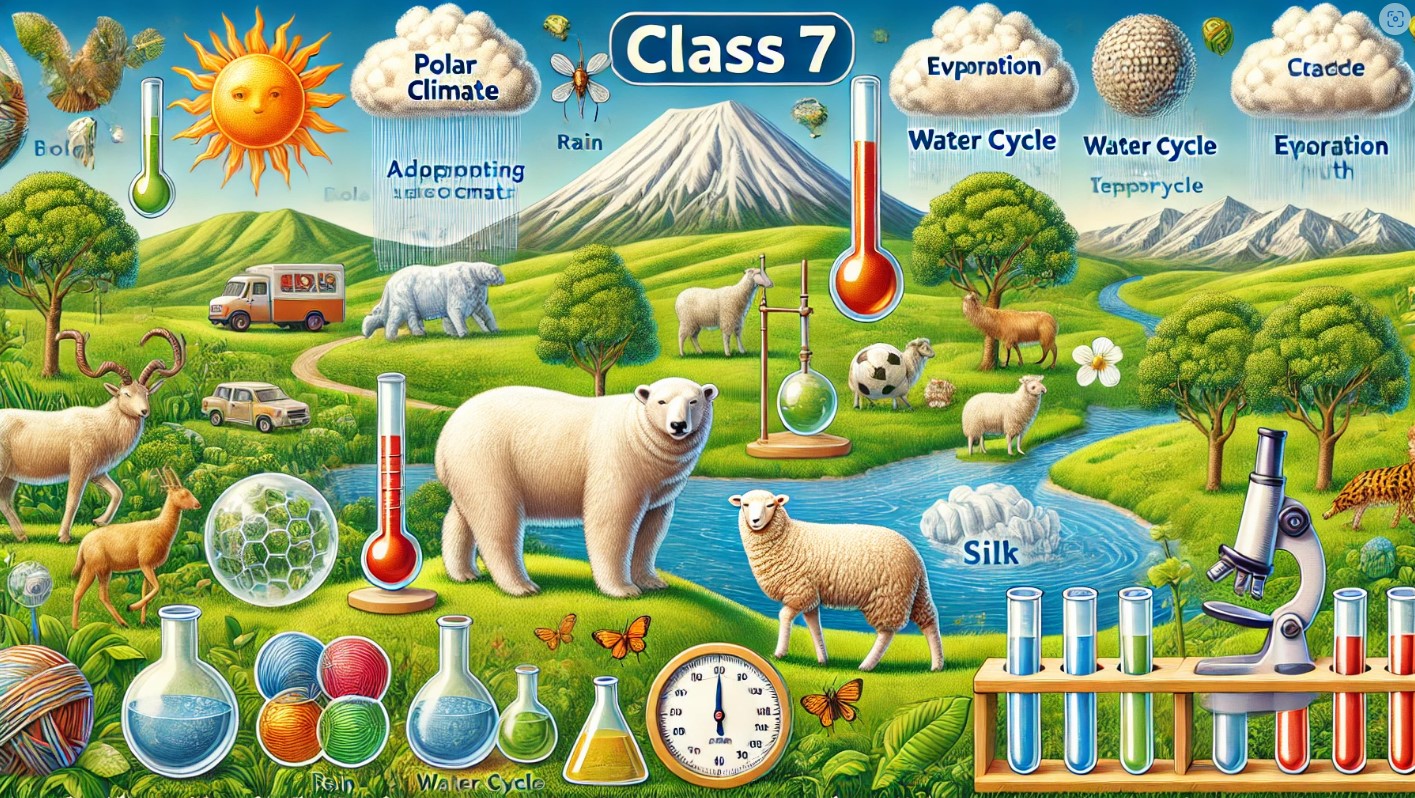
Class 7 – Science

Categories: Class 7
Wishlist Share
Share Course
Page Link
Share On Social Media

Course Content

🐻 Animal Adaptations to Climate 🌍 | Polar Bears to Toucans – Survival Secrets! 🦜
Adaptations in animals are nature’s way of survival! In this Class 7 Science video, we’ll dive into the fascinating world of how animals adjust to harsh climates, from the icy Polar Regions to the lush Tropical Rainforests. Learn how different animals have developed unique features to thrive in extreme conditions. This lesson will also explore the climates of these regions and their impact on wildlife. Watch till the end to uncover nature’s wonders!

  • 🐻 Animal Adaptations to Climate 🌍 | Polar Bears to Toucans – Survival Secrets! 🦜
    08:10
  • Quiz – Adaptions of Animals to Climate

🧵 Fibre to Fabric : Silk 🦋 | Discover the Secrets of Silk! 🌟
Silk, a natural fibre, has been treasured for centuries for its softness, sheen, and strength. This lesson focuses on the incredible journey of silk—from the silkworm’s cocoon to the fabric we wear. By the end of this video, you will gain a thorough understanding of the following key subtopics: 1. What is Silk? Silk is a natural fibre produced by silkworms. It is primarily composed of proteins and is known for its smooth texture and shiny appearance. Silkworms spin silk to form their cocoons, which humans then process to create threads for weaving fabric. 2. History of Silk The history of silk dates back thousands of years, originating in ancient China. Legend has it that the process of silk production was discovered by Empress Leizu, who noticed silkworms spinning cocoons. Over centuries, silk became a valuable trade commodity, with the "Silk Road" connecting China to other parts of the world. 3. Characteristics of Silk Silk has several unique properties: • Softness: Silk is smooth to the touch. • Shine: Its natural luster gives it a luxurious appeal. • Strength: Silk is strong and durable. • Lightweight: It is incredibly lightweight, making it comfortable to wear. • Insulating: Silk provides warmth in cold weather and stays cool in hot weather. 4. Types of Silk Different varieties of silk are produced worldwide, depending on the species of silkworm and the production methods. Common types include: • Mulberry Silk: The most common and highest-quality silk. • Tasar Silk: Known for its texture, typically produced in India. • Eri Silk: Produced without killing the silkworm, making it eco-friendly. • Muga Silk: A rare silk with a natural golden tint, primarily found in Assam, India. 5. Life Cycle of a Silk Moth The silk moth’s life cycle has four main stages: • Egg: Female silk moths lay eggs on mulberry leaves. • Larva (Caterpillar): The eggs hatch into larvae, which are fed mulberry leaves. • Pupa (Cocoon): The larva spins silk threads to form a protective cocoon. • Adult Moth: Inside the cocoon, the pupa transforms into an adult moth. 6. Process of Obtaining Silk from Cocoon To obtain silk, the cocoons are boiled in water to soften the silk threads. The threads are carefully unraveled, spun into yarn, and woven into fabric. This process is labor-intensive and requires great skill to preserve the quality of the silk.

Fibre to Fabric : Wool

Forest : Our Lifeline

Heat

Heat Effects and modes of Transfer

Heating Effect of electric Current

Indicators

Magnetic Effect of Current

Motion and Time

Nutrition in Animals

Nutrition in Plants

Physical Changes

Respiration in Organisms

Simple Pendulum

Transportation in Animals

Transportation in Plants

Types of Respiration

Water a Precious Resource

Water Management

Weather and Climate

Student Ratings & Reviews

No Review Yet

No Review Yet

Want to receive push notifications for all major on-site activities?